Create one polished public-gallery concept image titled "Use Case Wayfinding: Prompt Glyph Concourse".

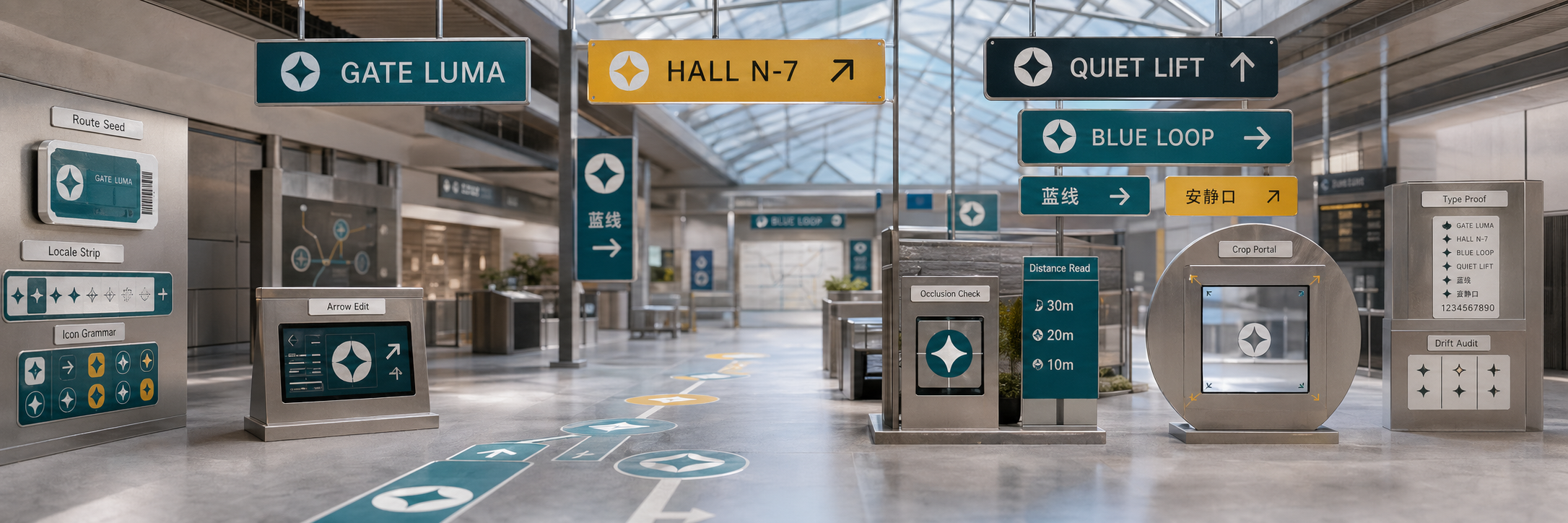
Output format: one ultra-wide 3:1 architectural interior photograph of a fictional miniature transit concourse built as a typographic stress-test diorama, not a grid, not a contact sheet, not a dashboard, not cards, not a board game, not a tray, not a cabinet, not a bakery deck, not a snowglobe, not a water basin, not a wardrobe, not a fossil drawer, not a toy latch, not a loom, not a proof press, not a planetarium, not an elevator.

Scene: a tiny unbranded indoor station with no train, no people, no real place, no logos. Suspended signs and floor arrows use invented route names only: "GATE LUMA", "HALL N-7", "QUIET LIFT", "BLUE LOOP", plus short Chinese labels "蓝线" and "安静口".

Mechanism: GPT Image 2 prompt control becomes wayfinding QA. Readable labels on small inspection tabs: Route Seed, Locale Strip, Icon Grammar, Arrow Edit, Occlusion Check, Distance Read, Crop Portal, Type Proof, Drift Audit. The same invented star-window glyph appears on every sign, ticket, and floor marker; arrows test spatial instruction following, bilingual signs test text rendering, occluders test partial visibility, crop portals test aspect changes, and distance markers test legibility.

Visual language: premium miniature architectural photography, glass ceiling, brushed aluminum, enamel signs, teal and saffron wayfinding, sharp readable type, shallow depth of field, family-safe, fictional, original, unbranded, rights-safe. Avoid political content, public figures, real brands, celebrity likenesses, copyrighted characters, explicit material, harmful instructions, weapons, gore, and living-artist style imitation.
Source note: Original fictional wayfinding QA prompt mechanism generated locally from existing-gallery gap analysis. Official OpenAI documentation was used only for factual capability framing around image generation, editing, text rendering, and multi-turn workflows; no external prompt, image, artwork, visual style, brand, character, repository, or case-study mechanic was reused.
GPT Image 2 Model
OpenAI
Confirmed high-quality generation/editing, flexible image sizes, and high-fidelity image input support; no prompt text, image, visual style, or case-study mechanism reused.
Accessed 2026-04-26 · OpenAI website terms; cited for factual capability context only
Open source link
Image generation - OpenAI API
OpenAI
Confirmed generation/edit endpoints and multi-turn image workflows; no prompt text, image, visual style, or case-study mechanism reused.
Accessed 2026-04-26 · OpenAI documentation terms; cited for factual capability context only
Open source link
Introducing our latest image generation model in the API
OpenAI
Confirmed broad practical use-case categories and text-rendering/instruction-following context; no prompt text, image, visual style, or case-study mechanism reused.
Accessed 2026-04-26 · OpenAI website terms; cited for factual capability context only
Open source link